Rosalie Fawkes interviews former British soldier, Mr. John Phillpot.
“Ask not what your country can do for you but what you can do for your country.”
— John F. Kennedy
A few weeks ago, I was having a telephone conversation with Rev. Emmette Weir about his forthcoming book titled, “From Pompey to Pindling” when, in a very nonchalant manner, he mentioned that one of the British soldiers who came to Nassau in 1958 to preserve law and order during the General Strike was still on the island.
“Really?” I responded in disbelief.
“Yes,” replied Rev. Weir, “his name is John Phillpot.”
“Oh, I know of him and have seen him in passing. That’s quite a revelation. I would really like to interview him to gain his perspective on the strike.”
“I will call him and get back to you.”
Mr. Phillpot agreed to the request and when I contacted him by telephone, he set up the interview to take place at the Boys Scouts’ Headquarters where he serves as the President of the association.
“Wow,” I thought – what a coincidence- the gentleman works at a building that is only a one-minute car drive from the place of my employment, The Young Women’s Christian Association of The Bahamas. For those who may not be familiar with the events of 1957 and 1958 that brought Phillpot to the island, here is a brief background:
HISTORICAL BACKGROUND TO THE GENERAL STRIKE
A dispute surfaced in 1957 when the Government granted to the white tour companies the exclusive franchise to operate transportation services between the new Nassau International Airport and Downtown, Nassau. In anticipation of the increased demand for their services, the tour companies purchased a fleet of buses and told the members of The Bahamas Taxi-Cab Union that their services were no longer required.
The grievances of the black taxicab drivers were ignored by the Government until Sir Clifford Darling and other union leaders decided to use their taxicabs to stage a blockade that brought to a halt all traffic to and from the Nassau International Airport.
However, when the Taxi Union could meet with no success, they approached Sir Randol Fawkes and The Bahamas Federation of Labour and appealed for assistance. The Federation moved swiftly and sought “approval for a resolution to launch a general strike to protest the denial of freedom of association to hotel and agricultural workers in support of the cause of The Bahamas Taxi-Cab Union and of Labour’s struggle generally for greater dignity and respect on the job site.” So, what started as a simple dispute between the taxi union and the Government and hoteliers mushroomed into a mass protest against the Bay Street merchants and the forces of colonialism.
Fawkes stated that the strikers were not demanding any loosening of ties with the British Crown but were insisting on reforms in the governmental structure. “Unless we get our rights, we will strike until kingdom come. This strike will be the beginning and the end of all evils inherent in British Colonialism.”
Sir Raynor Arthur, the Governor, alerted the Commander of the Caribbean area about the incident and asked for a company of British troops to be sent from Jamaica. He initially feared that the tense racial situation might result in disorder and violence. In an interview with a reporter from The Miami Herald, he said, “I’m prepared to crush with armed forces any such disturbance.”
Sir Randol, on the other hand, knowing that lives were at stake, had adopted a course of non-violence. “It was always our conviction that a bloody revolution would defeat our purpose; besides, it would be exactly the pretext Government wanted to spray down innocent men, women and children and to blame the whole massacre on irresponsible trade union leadership.
“Our advice was to ‘STAY CALM – BE CALM. Let us win this battle with A MIGHTY MEEKNESS. THIS IS OUR SUPREME HOUR!’ In fact, the people behaved so well that the law courts were forced to close their doors because of a lack of business.”
THE ARRIVAL OF THE ROYAL WORCESTERSHIRE REGIMENT
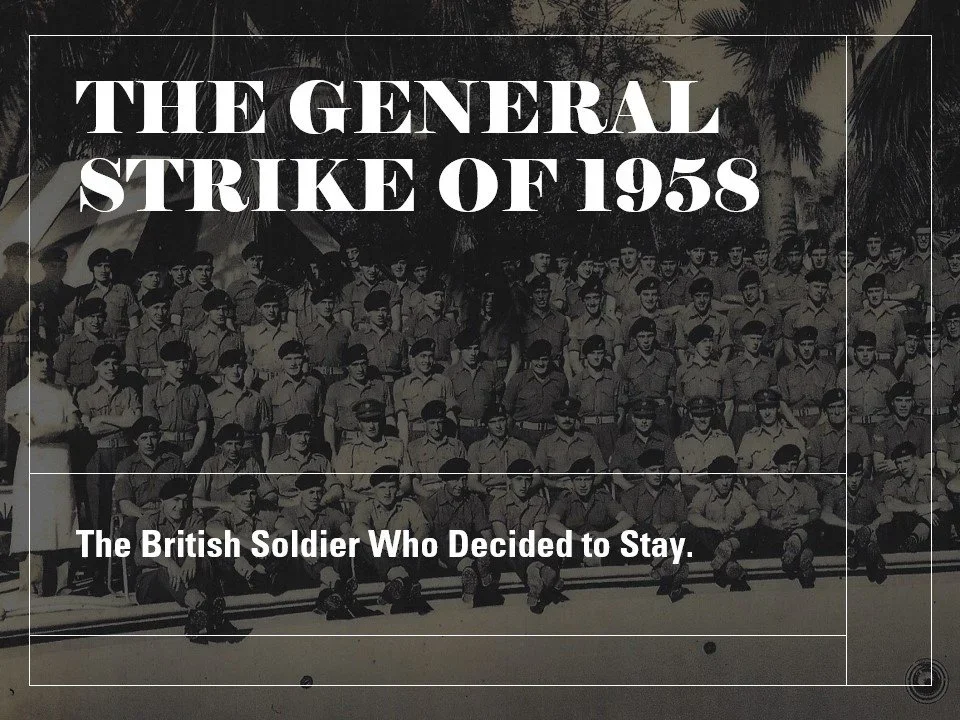
In the meantime, as the strike efforts in The Bahamas started to intensify, John Phillpot a young, British grocer who had decided to complete his two years of national service by enlisting in the armed forces was, at the time of the General Strike, stationed in British Honduras (Belize) when communications reached the soldiers informing them of their imminent departure from British Honduras to The Bahamas where there was political unrest.
The soldiers traveled to Nassau via Jamaica where they received briefings on the situation. Young John arrived in Nassau on January 14th, 1958 and he and the men in his regiment were collected in military vehicles and taken to the police barracks. They subsequently had a 19 day stay at the Royal Victoria Hotel which had been recently refurbished.
During his tenure in Nassau, John was one of two chefs assigned to the regiment while other soldiers were stationed at The Bahamas Electricity Corporation, Water and Sewerage, the International Airport, Government House, Bay Street and Batelco. All of this strategizing was done in an effort to maintain law and order in the country.
In June of 1958 the soldiers attended a reception hosted by the Imperial Order of the Daughters of the Empire. It was on this auspicious occasion that he met and fell in love with a young Bahamian lady by the name of Lorraine Gates whom he would later marry. Mr. Phillpot stated that he was drawn to the island and to the people whom he described as being friendly and sociable and reported that he got along very well with everybody. As time passed, John came to the realization that beyond a shadow of a doubt he wanted to remain in The Bahamas. Since those days, he has only returned to Great Britain on holiday excursions and said persons there never quite understood why he wanted to leave his country of origin for a place that many of them had never heard of in their lives.
He eventually broke his contract with the army – not an easy undertaking at all- and commenced settling in The Bahamas. It was in 1958 that a gentleman by the name of Arthur Smith approached him and asked if he would be interested in becoming a Scout Leader. John’s involvement with scouting dates back to 1946 when he started as a cub scout in England. He has since served as Scout Leader, Group Scout Leader, Commissioner, Chief Commissioner, Chief Scout and President, a position he currently holds. Additionally, he has held many other leadership posts not only in scouting but at his home church, Ebenezer Methodist Church and has been the President of the Rotary Club of New Providence for two terms.
At the beginning of my conversation with Mr. Philpot, the first thing that he had to say to me and before mentioning anything about himself was that The Bahamas would benefit greatly from a national service program. I thought nothing of his initial comments at the time but by the end of the interview and on reading more of the biographical notes that had been supplied, I could see that he not only talks about how we can improve the country but he has lived what he preaches. I commend him for his unselfish contributions to the nation and we are grateful for the hundred if not thousands of lives that he has touched. We can say there was one soldier who came and saw a need and never stopped giving. Thank you, Sir. Glad for the opportunity to have met you.
WHAT THE GENERAL STRIKE ACHIEVED FOR THE BAHAMAS
On January 29th, 1958, His Excellency, at last, brought representatives of the tour companies and the Taxi Union together at a top-level conference. At the end of the talks, a detailed agreement providing for the more equitable division of transportation of passengers to and from the airport was signed.
Moreover, as a result of the General Strike, additional labor reforms came about as well. Within three months of the strike, a senior British cabinet minister was in Nassau pushing for constitutional reforms and later in the year, legislation was passed to set up a Labor Department and a process for industrial conciliation. The following year saw the abolition of the company vote; the extension of the franchise to all men over 21; the creation of four new parliamentary seats (all of which were later won by the PLP); reduction of the plural vote to two; full adult male suffrage, regardless of property qualifications; the right of hotel and agricultural workers to join unions and the B.F. of L. won substantial wage increases and overtime pay for construction workers at the Nassau Beach Lodge.