Labour Appeals In Coral Harbour Crisis
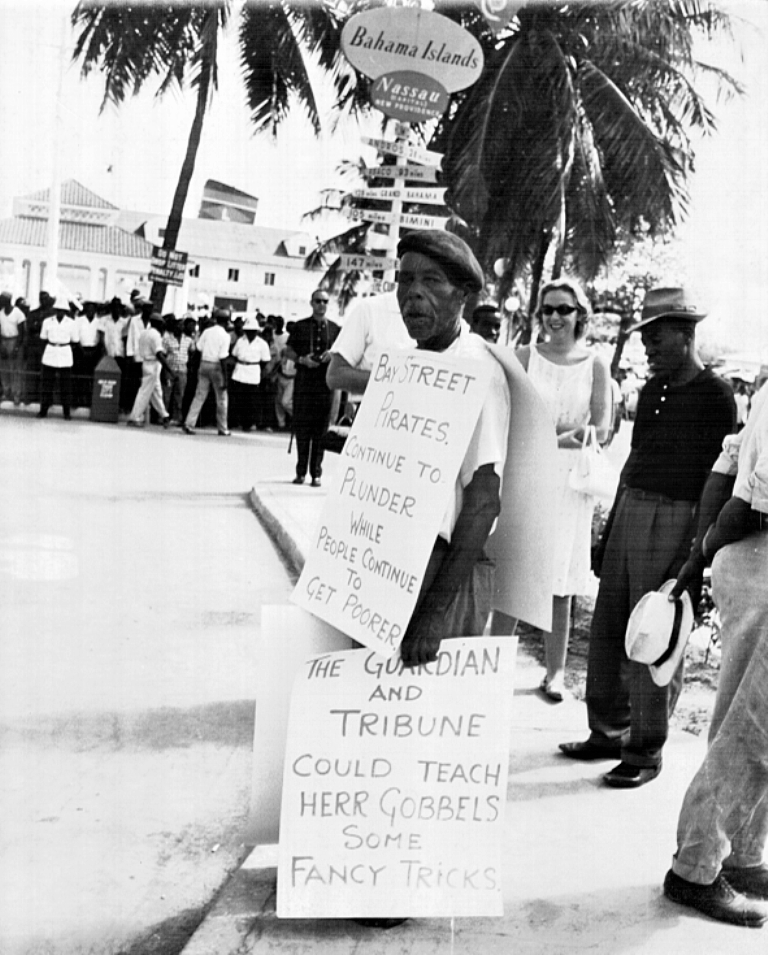
Labour To Appeal In Coral Harbour Crisis
The Nassau Herald
Saturday July 9th, 1955
Mr. C. F. Wheeler, head of the Personnel Department of the Coral Harbour project, has informed Mr. Randol Fawkes, founder of the Bahamas Federation of Labour, that "however anxious I am to help Bahamians, the promoters were conducting their project in accordance with the prevailing customs in the Bahamas." Mr. Wheeler said that he, personally did not agree with the principles of unionism.
It was reported in well-informed circles this week that prominent Bahamians in Government have set the scale of wages for the Coral Harbour promoters.
They have insisted that the American promoters keep the wages they pay Bahamian workers in line with those paid by local contractors.
Mr. Fawkes told The Herald that he visited Coral Harbour on several occasions within the past month and on each occasion, he found an implacable situation persisting in the working conditions of Bahamians.
"I was deeply concerned when I found that common labourers and other workmen were forced to work at the despicable wage of 2s.
11d. per hour and a 60-hour week," the Federation's President said.
“The situation is indeed serious and calls for immediate Government intervention.
“It will be recalled that a similar situation existed before the labour disturbances of 1942. This date is still fresh in the memory of Bahamians.”
Late this week Mr. Fawkes called upon the labour Board to "reconcile the impending differences," in order that a labour crisis, stemming from a misunderstanding of wages, hours and conditions of work, may be forestalled.
Thursday Mr. Fawkes addressed the following letter to the labour Board:
I am writing on behalf of The Bahamas Federation of labour and for over two thousand workmen who appear daily at the Employment Centre in search for good jobs, good wages and good conditions of work.
The mental attitudes of these men have matured considerably over the past decade, and as a result, they are fast becoming members of legally organized labour unions for the protection which such organizations afford.
In my legal right to 'organize the unorganized' and my duty to find jobs for the unemployed, I visited Coral Harbour twice within the past month and on each occasion found an implacable situation persisting in the working conditions of Bahamians.
At the period of my visits to Coral Harbour, there was, as is now, only a skeleton crew on hand; but I was appalled to find skilled men watering plants and labour foremen cutting bushes. Our concern was even more aroused when we learned that common labourers and other workmen were forced to work at the despicable wage of two shillings and eleven pence (2/11) per hour without hardly any compensation for the tremendous amount of overtime. In simple terms, gentlemen, these men who are grossly under paid, are actually doing the equivalent of two (2) weeks' work without receiving one (1) week's full pay.
During both of my visits I was approached by workmen who had but one desire: to become a part of a labour union in order that they may have some semblance of security against the unfair practices of the employers.
I corresponded with the promoters of Coral Harbour and finally succeeded in bringing these matters to the attention of Mr. C. F. Wheeler, the head of the Personnel Department who, however anxious he may be in helping Bahamians, maintained that the promoters were conducting their workshop in accordance with the prevailing customs in the Bahamas and that he, personally did not agree with the principles of unionism.
Needless to say, the workmen to whom I referred and the thousands whom I represent feel that such exploitation of human sources will inevitably lead to a labour dispute of no small proportions and we solicit the aid of the Labour Board in our efforts to reconcile the impending differences.
In accordance with sections 5 and 8 of the Labour Board Act 1946 the Federation of Labour would appreciate the Labour Board
making recommendations to the Governor-in-Council at the earliest possible moment in respect to the following matters:
(1) The setting up of a fair minimum wage for common labour below which the salary of no worker at Coral Harbour may fall; (say 4/6 per hour).
(2) The introduction of the 40 hour week and payment of time and a half for hours in excess of 40 a week; and that such ruling be retroactive as to restore to the present workers at Coral Harbour the full fruits of their past labour hours.
(3) A declaration that the undersigned has a legal right to enter the premises at Coral Harbour during all reasonable hours to protect union members and to contribute toward the settlement of any trade dispute involving their interests.
(4) The drafting of a suitable Collective Bargaining Agreement between the workers, when organized, and the Promoters of Coral Harbour incorporating clauses in respect to:
(a) Wages: 40-hour week; time and a half payment for overtime and double time for holidays and Sundays.
(b) Rest Periods: Ten minutes break in morning and another ten minutes recess in the afternoon.
(c) Grievance Procedure: Security against being fired or laid off without just cause, and without a good investigation into the justice of the dismissal.
(d) Group Insurance: A scheme providing insurance for the worker in cases of sickness or accident, and benefits to the family in case of death.
Without delving into the basic philosophy of unionism the group of present and prospective employees believe in the efficacy of the bargaining table as the one and only instrument for helping management and labour to learn to live and work together in peace and we would welcome an opportunity to sit down and talk over problems with the promoters in order that both parties may achieve the maximum benefits from the construction of the project.
On behalf of those who toil I beg to express the hope that the Labour Board may give to the employers justice, and to the toiling thousands—a fulfillment of their abiding faith in the promises of democracy."